Jonathan Crook's plenary, Mathematics in Finance conference, South Africa
20 July 2026
Can weather events and climate conditions help predict the chance a borrower defaults on their mortgage? A recent paper by Viani Djeundje Biatat, Jonathan Crook and Galina Andreeva finds that they can.
In July 2026, Jonathan delivered a plenary presentation at the Mathematics in Finance conference, jointly organised by the University of Cape Town, North West University and the University of Pretoria, and attended by more than 100 delegates from all corners of the world.
The presentation showed that model accuracy improves when a range of weather variables and flexible statistical relationships are included, and that omitting weather predictors in regions such as California can lead banks to underestimate the capital they need to hold against severe events.
Jonathan also presented a second paper from the same research team, on a methodology for predicting a mortgage's expected future cash flow at any point in its life, incorporating anticipated changes in the macroeconomy. The method adjusts expected cash flow as an account holder moves between different states of delinquency, even where they do not ultimately default.
References
Djeundje, V., Crook, J.N. and Andreeva, G. (2026) "Disentangling Environmental and Economic Risks in Mortgage Default: A Spatio-Temporal Modelling and Stress-Testing Framework with Capital Implications." Available at SSRN
Djeundje, V., Crook, J. and Andreeva, G. (2025) "The Devil in the Details: Dynamic Prediction of Loan Profitability with Macroeconomic Drivers through Multistate Modelling." European Journal of Operational Research, 327(2), 703-715.
CRC contributes to Federal Reserve Bank of Philadelphia Workshop on Innovations in Credit Scoring
13 July 2026
On 13 July 2026, the Federal Reserve Bank of Philadelphia and the Supervisory Research Forum (SURF) hosted the Workshop on Innovations in Credit Scoring. This full-day virtual event looked at how AI, machine learning and alternative data are changing credit scoring, and what that means for transparency, data privacy, risk management and access to credit.
The workshop's two academic advisors were Professor Stefan Lessmann of Humboldt University of Berlin, an external affiliate of the Credit Research Centre, and Galina Andreeva, Professor of Societal Aspects of Credit and Director of the Credit Research Centre.
Galina also chaired the panel “The Future of Credit Scoring”, which brought together Kiran Aware of Happen Bank, Rikard Bandebo of VantageScore, Professor Cristián Bravo of Western University, Ethan Dornhelm of FICO, Dmytro Kolechko of Wing Bank, Stefan Lessmann and Dan Richard of Prism Data.
In the first module, Stefan presented “Beyond Traditional Scoring: Harnessing Advances in AI to Improve Predictive Accuracy”, and he went on to chair the second module. Dmytro Kolechko, CEO of Wing Bank, presented “Digital Footprint Credit Scoring Modeling”, the paper that won the Best Paper Award at the Centre’s Credit Scoring and Credit Control Conference in 2025.
The programme also included a keynote by Catherine Tucker and research presentations on AI, machine learning and alternative data from academia and industry.
Professor Galina Andreeva Delivers Keynote in Bangkok
26 June 2026
On 26 June 2026, Galina Andreeva, Director of the Credit Research Centre, delivered a keynote at the 3rd Annual Credit Risk Model Conference, held in Bangkok.
Her keynote, "The Credit Research Centre: Era of AI, Regulation, and Societal Scrutiny," explored the evolving landscape of credit risk modelling at a time when artificial intelligence, regulatory expectations and societal accountability are converging.
CRC joins Nature Finance Lab and Bank of England on Climate, Nature and Credit Risk
1 June 2026
On 1 June 2026, the Business School's Nature Finance Lab launched its Frontiers in Nature Finance series with an afternoon on climate, nature and credit risk and the challenges they pose for the UK banking sector. The event was run in collaboration with the Credit Research Centre, with support from Edinburgh Innovation, and hosted in partnership with the Bank of England.
After an introduction from Professor Raffaella Calabrese, Benjamin Guin of the Bank of England spoke on green mortgage innovation, and his colleague Mahmoud Fatouh on how biodiversity interacts with default risk in the UK mortgage market. Scott Harrison of Experian looked at how banks can source and act on climate and nature risk data, Douglas Phillips of Arup gave an overview of the Taskforce on Nature-related Financial Disclosures, and Christopher Sterley of True North Partners spoke on advancing climate risk models to capture nature risk. Viani Djeundje Biatat of the Credit Research Centre presented research on wildfires, weather, mortgage defaults and capital.
The afternoon closed with a panel discussion and a summary from Peter Baker of Edinburgh Innovations.
CRC's 13th Special Issue Explores Credit Risk Modelling in a Changing World
20 May 2026
Following a long tradition since 1992, CRC is delighted to announce its 13th Special Issue, exploring Credit Risk Modelling in a Changing World.
The editors describe the discipline as being at "a critical juncture," shaped by fast-moving technology, tightening regulation, and growing scrutiny of algorithmic decisions.
Automated credit scoring is now standard practice across retail and corporate lending in the financial industry, a direct application of decades of quantitative methods research. This special issue continues that tradition, advancing knowledge and application at a time when that scrutiny and regulatory pressure are continuously increasing.
Edited by Galina Andreeva (Edinburgh), Jonathan Crook (Edinburgh) and Christophe Mues (Southampton), and published in May 2026 in the Annals of Operations Research, the issue is linked to the Centre's Credit Scoring and Credit Control conferences, held since 1989.
The contributions span four areas. On stress-testing and loss modelling, papers examine how transition matrix choices shape long-run default projections, extend stress-testing methods to IFRS 9 overlays, and propose new ways to estimate loss and profitability in online lending. On machine learning and alternative data, authors draw on sources as varied as social media, ESG reports and satellite imagery to strengthen credit rating and scoring models. Further research tackles practical concerns beyond default prediction, from reject inference to fraud detection to model monitoring.
Finally, a standout paper turns to algorithmic fairness, examining how credit models can amplify inequity across intersecting characteristics such as gender, age and marital status. A question of growing importance as automated decisions play a larger role in who gets access to credit.
Director of CRC participates in FCA Roundtable to evaluate HCSTC Price Cap amid Economic Shifts
30 April 2026
In April, Prof Galina Andreeva, Director of the Credit Research Centre, participated in an FCA Roundtable to review the High-Cost Short-Term Credit (HCSTC) price cap, in place since 2015.
As background, the price cap means that when HCSTC loans are taken out or rolled over, the combined interest and fees charged must not exceed 0.8% per day of the amount borrowed. If borrowers default, fees must not exceed £15. Firms can continue to charge interest after default but not above the initial rate. Finally, borrowers must never have to pay more in fees and interest than 100% of what they borrowed.
The price-cap was last reviewed in 2017. Since then, the market and wider economic environment have changed significantly, both for consumers and firms.
In 2017, the FCA made the decision to maintain the HCSTC price cap at its current level and committed to looking at it again after three years but chose to delay because of Covid and the cost-of-living challenges.
This Roundtable offered a key opportunity to consider whether the price cap continues to work effectively in the interests of consumers and markets and remains fit for purpose in the current economic environment.
CRC Launches Executive Education Course in Climate Stress Testing and Climate Scenarios
10 March 2026
The Credit Research Centre (CRC) is pleased to announce the launch of a new executive education course, Climate Stress Testing and Climate Scenarios, developed in collaboration with the University of Edinburgh Business School's Centre for Business, Climate Change, and Sustainability (B-CCaS).
The course has been designed specifically for financial institutions and is led the CRC’s own Dr Raffaella Calabrese, and Dr Joseph Breeden, CRC External Affiliate, CEO of Deep Future Analytics LLC, and President of the Model Risk Managers’ International Assocation.
About the Course
Participants will gain both the conceptual foundations and practical tools to assess the financial implications of climate change for credit risk. The course covers how to select and apply appropriate climate scenarios, how to integrate climate-related risks into existing credit risk frameworks, and how to evaluate the resilience of loan portfolios under severe stress conditions. It is designed to be tailored to the specific needs of individual organisations, and prospective participants are encouraged to contact the Business School to discuss collaboration opportunities.
The course is particularly well suited to credit risk modellers, senior risk managers, and financial professionals seeking to build or strengthen their organisation's capacity in this rapidly evolving area.
The research behind the course
Climate Stress Testing and Climate Scenarios draws on a substantial and growing body of research on stress-testing developed by the CRC with Raffaella and Joe making meaningful contributions (please see the details below). State-of-the art stress-testing approaches developed for macroeconomic impacts have found a novel and profound application in addressing climate change issues and their estimations.
The climate applications continue a long-standing legacy of stress‑testing methodologies advanced by CRC founder, Professor Emeritus Jonathan Crook, and other CRC members and External Affiliates:
- Djeundje & Crook (2025), Incorporating behavioural and macroeconomic correlations for the prediction of bank capital for credit risk.
- Wang, Crook, Andreeva (2025), Sensitivity of model parameter estimates in stress testing the probability of default: evidence over the financial crisis.
- Bocchio, Crook &Andreeva (2023), The impact of macroeconomic scenarios on recurrent delinquency: A stress testing framework of multi-state models for mortgages.
- Djeundje & Crook (2022), Sensitivity of stress testing metrics to estimation risk, account behaviour and volatility for credit defaults.
- Wang, Crook & Andreeva (2020), Reducing estimation risk using a Bayesian posterior distribution approach: Application to stress testing mortgage loan default.
- Bellotti & Crook (2014), Reducing estimation risk using a Bayesian posterior distribution approach: Application to stress testing mortgage loan default.
- Bellotti & Crook (2013), Forecasting and stress testing credit card default using dynamic models.
By grounding learning in proven stress‑testing methodologies, the course enables participants to understand not only how climate scenarios are constructed, but also how they can be embedded in empirical models relevant for financial decision‑making through example from Raffaella’s and Joe’s work.
Dr Raffaella Calabrese's research focuses on the quantitative modelling of climate risk in lending and mortgage markets. Two recent studies are of particular relevance to the course. Her work on the impacts of extreme weather events on mortgage risks in Florida — examining how hurricane and flood exposure affects default behaviour and how those relationships evolve under projected climate change scenarios — provides a compelling empirical foundation for understanding physical climate risk at the asset level. A complementary study on climate stress testing for mortgage default probability develops methodological tools for translating macro-level climate scenarios into granular credit risk estimates, offering practitioners a direct pathway from scenario design to portfolio-level impact assessment. Raffaella also designs and delivers executive courses for the European Central Bank on Climate Stress Testing and the EU Supervisory Digital Finance Academy.
Dr Joseph Breeden's contributions bring a complementary focus on the practical dynamics of climate stress in lending. His 2023, Impacts of Drought on Loan Repayment, examines how prolonged drought conditions affect borrower repayment behaviour, drawing on empirical data to quantify a risk that is increasingly material for agricultural and regional lenders, but whose methods and findings carry wider lessons for physical risk modelling.
A second paper, co-authored with Y. Leonova and A. Bellotti, examines instabilities in the use of Cox Proportional Hazards models for loan portfolio forecasting and stress testing — a technically important contribution that speaks directly to the reliability of the modelling approaches practitioners use when assessing portfolio resilience under adverse scenarios.
A collaboration rooted in complementary expertise
The partnership between the CRC and B-CCaS represents a natural alignment of strengths. The CRC brings deep expertise in credit risk analytics, scorecard development, and financial modelling, while B-CCaS contributes specialist knowledge in climate science, sustainability strategy, and the policy dimensions of climate-related financial risk. The joint development of this course reflects the University of Edinburgh Business School's ambition to translate interdisciplinary research into professional practice.
The CRC looks forward to supporting financial institutions in building the analytical capabilities they need to navigate the risks and responsibilities that climate change presents to the credit sector.
Course presenters

Raffaella Calabrese, Professor at the University of Edinburgh Business School
Dr Calabrese works closely with financial institutions and regulators to propose analytical solutions to better measure the effects of climate change on credit risk and how to perform climate stress testing exercises. Raffaella collaborates with financial institutions, government bodies and regulators in the UK, USA, China and multiple EU countries. She provides training on Climate Stress Testing at the European Central Bank and on digital finance at the European Commission.

Joe Breeden, Chief Executive Officer at Deep Future Analytics LLC
Dr Breeden has been designing and developing risk management systems for loan portfolios since 1996. He founded Deep Future Analytics in 2011, which focuses on portfolio and loan-level forecasting solutions for pricing, account management, stress testing, CECL/IFRS9, and AI monitoring; serving banks, credit unions, and finance companies. He also serves as President of Model Risk Managers’ International Association and on the board of Upgrade. Dr Breeden earned a PhD in Physics and published over 90 academic articles, 8 patents, and 6 books.
Advancing understanding of Model Risk
26 February 2026
The Credit Research Centre (CRC) continues to demonstrate its commitment to thought leadership in credit risk, analytics, and financial services through the delivery of targeted educational events that bridge academic insight and professional practice.
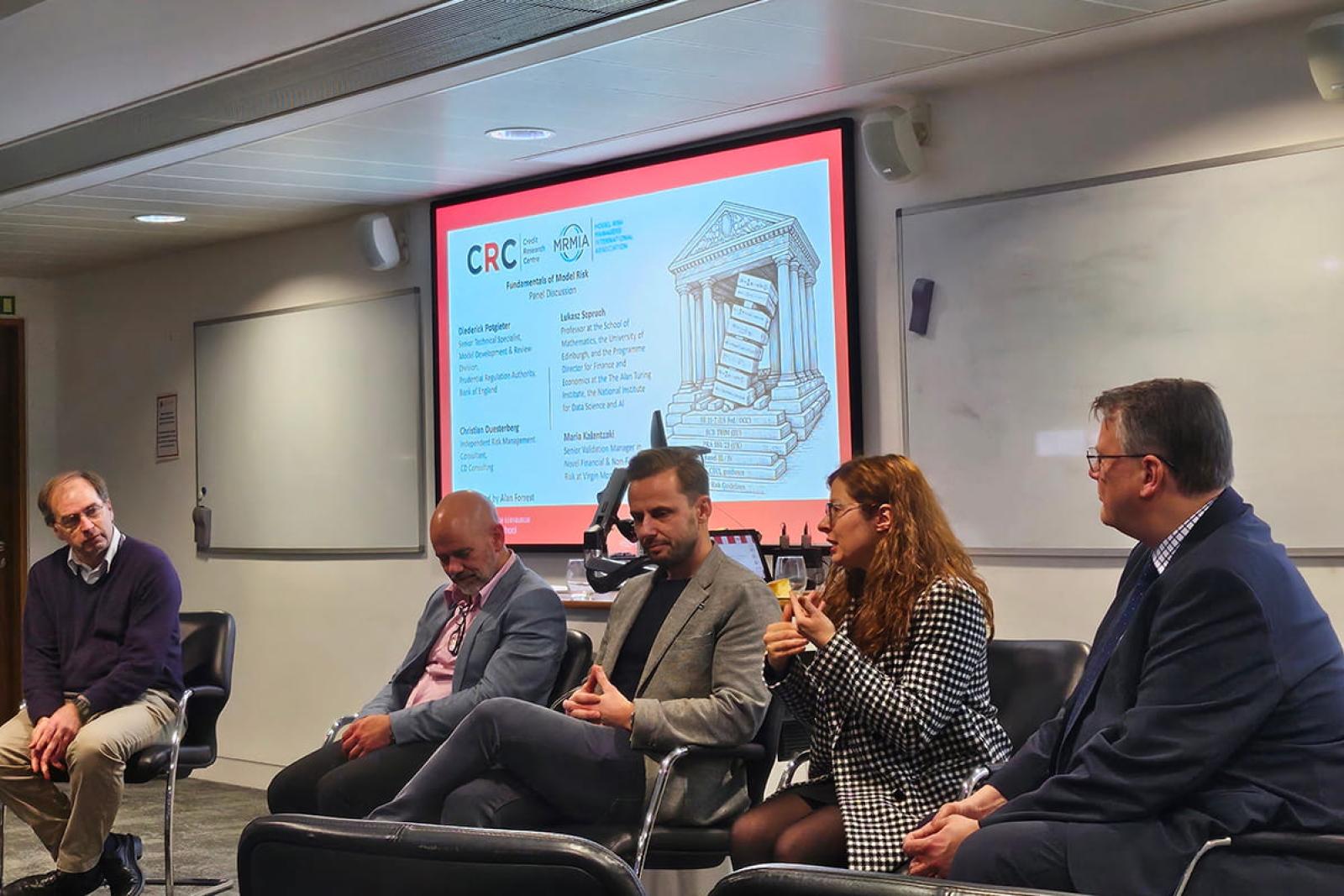
On the 19 February 2026, CRC partnered with the Model Risk Managers International Association (MRMIA) to host a comprehensive in-person session titled Fundamentals of Model Risk, bringing together regulators, industry experts, and scholars for a full-day exploration of one of the most pressing analytical challenges facing the financial sector today.
Why Model Risk matters
Models are central to decision-making across finance, analytics, and research, yet they are not infallible. Beyond routine testing and validation, models can embody incorrect assumptions, unstable specifications, shifting data environments, or improper application. Collectively, such vulnerabilities contribute to Model Risk, defined as the potential for loss resulting from the use of an unsound or misused model. As predictive analytics and machine learning expand in complexity and influence, a clear understanding of Model Risk is essential for robust decision-making, effective governance, and responsible innovation.
Building a strong foundation: Expert insight and practical guidance
CRC’s collaborative session engaged leading figures in model governance and quantitative risk, including:
- Dr Diederick Potgieter, Senior Technical Specialist in Capital Management at the Prudential Regulation Authority (PRA), Bank of England
- Christian Duesterberg, Risk Management Consultant with over 26 years’ experience in financial services
- Dr Alan Forrest, CRC Business Associate, MRMIA Board Member, and former senior model development and validation lead at Virgin Money UK, Royal Bank of Scotland, and Halifax Bank of Scotland
- Additional international experts in model risk and quantitative risk management
Through structured beginner sessions and an in-depth panel discussion, participants gained insight into how Model Risk manifests across modelling approaches, from classical statistical frameworks to advanced machine learning and generative AI. Indeed, the session included examples from law and engineering as well as financial services. Presentations examined how Model Risk is understood and regulated in the UK financial services sector, how seasoned practitioners identify and assess risk within model lifecycles, and how a Model Risk mindset enhances transparency, trust, and operational resilience.
Lukasz Szpruch, Professor at the School of Mathematics, the University of Edinburgh, and the Programme Director for Finance and Economics at The Alan Turing Institute, the National Institute for Data Science and AI, and Dr Maria Kalantzaki, Senior Validation Manager in Novel Financial & Non-Financial Risk at Virgin Money joined the evening session as panellists.
The featured discussion, moderated by Dr Alan Forrest, brought together regulators, academics, and industry leaders to reflect on both conceptual and practical dimensions of Model Risk. The panel session encouraged open dialogue under Chatham House rules, emphasising real-world implications and cross-sector learning.
Thought leadership that makes an impact
Events such as Introduction to Model Risk are not simply educational forums; they play a structural role in shaping how risk is understood and managed across the financial sector. By bringing regulators, industry leaders, and academics into the same room, CRC helped strengthen a shared language around Model Risk — one that moves beyond compliance toward deeper analytical accountability.
The discussion reinforced that Model Risk is not a niche technical concern, but a foundational element of modern decision-making. As modelling becomes more complex, particularly with the rise of AI and machine learning, a disciplined approach to identifying assumptions, understanding limitations, and communicating uncertainty becomes central to institutional resilience. By foregrounding these principles, the event contributed to embedding Model Risk thinking more firmly within professional practice.
Importantly, the collaboration between CRC and MRMIA demonstrated how academic insight and regulatory experience can jointly influence industry standards. Financial institutions increasingly operate in environments where model governance is both a regulatory requirement and a strategic necessity. Events like this support the cross-fertilisation of ideas and diffusion of best practice across organisations, helping practitioners adopt more structured, transparent, and defensible approaches to model development and deployment.
In doing so, CRC’s work extends beyond convening discussion - it contributes to shaping expectations, strengthening governance cultures, and supporting more robust, trustworthy analytical systems across the market.
Looking ahead
CRC remains dedicated to advancing research and practice at the intersection of credit risk, analytics, and financial services. Through events like Fundamentals of Model Risk and our ongoing Village Hall series Let’s Talk About, the CRC is proud to serve as a neutral hub for open and critical discussions.
The Credit Research Centre extends our heartfelt gratitude to MRMIA for sponsoring this event.